Wednesday, 30 September 2009
Year 2...............?!?!?

Monday, 25 May 2009
The World... Has It Gone Mad!?!?!?!?
Can it be that these so called celebrities can have such a massive influence over the public and their choices? for example look at Morrisons, they use people like Richard Hammond and Alan Hanson only to name a few of their celebrities, celebrities that the public can feel confident about you can see they have some form of morals (Hanson: Ex Liverpool Fc and Scottish International) shows that he is a good clean cut celebrity even though he might be ZZ LIST!! Can you imagine what kind of image this new Mammoth in grocery shopping would get if one of their celebrities were to do a line of Coke whilst on Holiday?!?!?!?!?!? Exactly it would go to "POT" pardon the pun.
I believe that these companies which used disgraced celebrities such as Kate Moss and Kerry Katona deserve all they get whether that be closing down or the fact they lose money!! They are quick to say they are happy to use these celebs but the second they put a foot wrong they are even quicker to say we dont want anything to do with them or even go so far as to say "we were not aware of their problem" Iceland decided to even get Kerry someone that could lend here a twenty pound note by deciding to bring Jason Donovan on board as well i mean with a biography titled "BETWEEN THE LINES: MY STORY" did the executives at Iceland not see the "Cracks" before they actually appeared? (( I must stop using those little punch lines)) ..... i am sure that was not icing sugar in their latest Christmas add together.....
The thing that grinds my gears more than anything is that people still seem to want to know about her either that or the news must just be very slow!!!!
Thursday, 30 April 2009
Finished...........1st year.........
Thursday, 23 April 2009
The Big Bad World Of Business.......
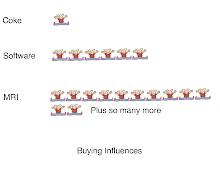
- Coca Cola - ONE
- Financial Services - Accounts Department & Purchasing (4 - 6)
- MRI Scanner - Board of Directors & Community (100's - 1000's)
Friday, 17 April 2009
Culture....We're All Apart Of It......!!
 We have reached our penultimate topic this week, and also quite possibly one the most varied topics to cover as Ruth 2009 says "We could talk about this forever" but i am not going to that,from the previous blog about children we can begin to understand just small concepts that can be picked up in marketing, after all cultures are often set by their generation by this i mean for example here in the UK at the beginning of this century it was about the Chav and now as we move on almost a decade the Emo has risen. Take a look at the list below;
- People’s perceptions of what is right and wrong
- Family values
- Society’s values and attitudes
- Community learning Communal or collective memory
These are all areas that we have covered over the last few months and you can now see how everything is starting to intertwine and come to an end result if you haven't already that is.
A great man once said "No culture can live, if it attempts to be exclusive" Mahatma Gandhi, which if you look at the world today people have learnt to accept new cultures and in some cases even becoming part of them by marrying into a different culture or having children with a person from a different culture some people are even going out of their way to learn about and understand different cultures.One thing i have noticed is that all cultures have something in common with another culture, whether that be from the colours of the robes worn by Hindu Priests and the colour of the Shaolin Monk dress wear.


There are millions of examples,from music right through to religion but to write them all out would be CRAZY! I have written about cultural similarities but there are also some massive cultural differences please watch the videos below to see just a few of them;
The last Video brings me on to stereotyping which can be summed up in a few sentences this was found by Ruth and written by Daniel B.Holeman
" Heaven is where the police are British, the chefs are French, the mechanics are German, the lovers Italian and it is all organised by the Swiss. Hell is where the police are German, the chefs are British, the mechanics French, the lovers Swiss and it is all organised by the Italians."
Understandably with thousands of cultures across the globe i am sure i can be forgiven for writing about them all? I have put some links below to sites that would help to explain certain aspects of different cultures.,
http://www.socialstudiesforkids.com/subjects/cultures.htm
http://www.cultures.com/ on this site click on the LINKS
http://www.freewebs.com/worldcultures/
The last site is probably the best one it allows you to see how the same nationalities seem to adapt differently to they're cultural surroundings depending on where they are on the planet take a look its very interesting,it also shows what is on offer from each culture in that specific country from Construction companies to Dance troops.
It would appear that there would be two main culture types in the UK that i can see High Culture and Pop Culture...... Both of these were taken from Wikidpedia.......
Popular culture (pop culture) ideas, perspectives and attitudes that are more easily accepted or if you like preferred within a given culture. Which have been heavily influenced by mass media (at least from the early 20th century on) although pop culture was recognised decades ago it has now become more mainstream than ever with the use of television,magazines and music, this collection of ideas affects the everyday lives of the society. Pop culture is often seen as being "dumbed-down" in order to accepted by society.
High culture is a term, now used in a number of different ways in academic discourse, whose most common meaning is the set of cultural products, mainly in the arts, held in the highest esteem by a culture. Matthew Arnold defined culture as "the disinterested endeavour after man's perfection".
Does culture take us back to the weeks of where we spoke about class? What do you think? Post a comment and let me know,i hope this was a good read and before i go watch these videos if you have the time........You will learn more than going on Facebook.......
Can "Great Literature" be Poorly reviewed?
Tuesday, 14 April 2009
Childish Marketing.........It Works........!!
But to Marketers and Advertisers and to Dr Alan Grant from Jurassic Park "A Child is a Small Adult"
Who knew that the key to the world of marketing could be so easily handled and easy to break through............ how i here you say? Children have slowly become the gateway for adult consumers to part with their hard earnt cash.... Just by putting the right product in front of children they instantly want it..... UNBELIEVABLE!!
Piaget "conepts formed are crude and irreverible" he further goes on to say "perceptions dominate judgement" baring mind that these comments were made at the age group between 4 and 7 they are critical ages as this is when children according to reasearch are at their most influencial.
Children represent three different markets. In addition to the direct money that children spend and the money they influence, children also represent a third major market and perhaps the most significant and that is the future market. Advertisers and Mareters recognise that brand loyalties have formed,whilst children are young and vulnerable these brands will be carried through to adulthood,althought deep down inside everyone is just a big kid.
Retailers and manufacturers have two sources of new customers, those who they can persuade to change from their competitors (THE ADULTS) and those who have not yet entered the market yet (THE CHILDREN). Those who switch are less likely to be loyal than those who are catered for from childhood, according to the CEO of Prism Communications M. McNeal "they aren't children so much as what I like to call `evolving consumers'." The following definitions of age were made by McNeal about the evolution satges of cild consumers.
From age 1: Accompanying Parents and Observing. Children are taken with their parents to supermarkets and shops where all sorts of goodies are displayed.
By the time a child can sit erect, he or she is placed in his or her culturally defined observation post high atop a shopping cart. From this vantage point the child stays safety in proximity to parents but can see for the first time the wonderland of marketing.
From age 2: Accompanying Parents and Requesting. Children begin to ask for things that they see and make connections between television advertising and store contents. They pay more attention to those ads and the list of things they want increases.
At the same time, the youngster is learning how to get parents to respond to his or her wishes and wants. This may take the form of a grunt, whine, scream, or gesture--indeed some tears may be necessary--but eventually almost all children are able on a regular basis to persuade Mom or Dad to buy something for them.
From age 3: Accompanying Parents and Selecting with Permission. Children are able to come down from the shopping trolley and make their own choices. They are able to recognise brands and locate goods in the store.
At this point the child has completed many connections, from advertisements to wants, to stores, to displays, to packages, to retrieval of want-satisfying products. For many parents this is a pleasing experience. Ditto for the marketers, for it signals the beginning of the child's understanding of the want-satisfaction process in a market-driven society.
From age 4: Accompanying Parents and Making Independent Purchases. The final step in their development as a consumer is learning to pay for their purchases at the check-out counter.
From age 5: Going to the Store Alone and Making Independent Purchases.
According to Direct Marketing magazine, by the age of eight children make most of their own buying decisions.
Modern children can often recognise brands and status items by the age of 3 or 4, before they can even read. One study found that 52 percent of 3 year olds and 73% of 4 year olds "often or almost always" asked their parents for specific brands. Advertisers recognise that brand loyalties and consumer habits formed when children are young and vulnerable will be carried through to adulthood. Kids `R' Us president, Mike Searles, says "If you own this child at an early age... you can own this child for years to come."
Have a look at what is being marketed to kids now.....
JUNK
TOYS
CARS?!?!?
Cars i can hear you shouting now!! Yes cars look at how the children are used to be like adults,they are the ones unpacking the cars,they are the watching the children sorry "Adults" playing. The use of this is so clever it works on so many different levels,one of them is showing how the children apparently made the decision for their parents to buy the Car how funny does that happen in real life? I believe it does, i believe that when buying a car fr your familt it has to be an all rounder,remember the "KIDS COME FIRST" on that decision,so sub conciously they are making the decision to buy the car. maybe there are too many points to write about now,but i hope you can see what i am trying to get at by showing that advert.....? Tom McGee and Kevin Heubusch did studies into this specific area "one study estimated that children influenced $9 billion worth of car sales in 1994. One car dealer explains: "Sometimes, the child literally is our customer. I have watched the child pick out the car."
Below is a chart that is taken from Laurie Klein this study was done in 1997 there is also a link to a story in a Newspaper about pocket

Paper
I have reached the conlusion that Children have to much POWER Adults need to start learning to say NO!!
Please have a look at my previous blog entitled My Family......... and click the link "Children Rule The Roost" enjoy
Friday, 20 March 2009
Luxurious Upper Class.................?!?!?!?
So this week is about social class and what it actually means, Sociologists define social class as the grouping of people by occupations. Doctors and lawyers and university teachers are given more status than unskilled labourers. The different positions represent different levels of power, influence and money.
The British society is often considered to be divided into three main groups of classes:
- The upper Class
- The Middle Class
- The Lower/Working Class
Is there still a need of this so called class system? Or is it just a want?
Social class is a division of society made up of persons possessing certain common social characteristics which are taken to qualify them for intimate, equal status relations with one another, and which restrict their interaction with members of other social classes
(Krech, Crutchfield & Ballachey in Dubois 2000)
I have put a few videos for you to watch about class and there are a few videos on how class is used by marketers.....enjoy them and then please continue reading my blog.....
LESSON ( This Link Is Puuka)
IF YOU DONT WATCH ANY OF THE OTHERS WATCH THIS ONE CLICK ON ME!!
•A B C1 C2 D E
•A – upper middle class
•B - middle class
•C1 – lower middle class
•C2 – skilled working class
•D – working class
•E –lower class
I have some questions for you.....
- Where do you class yourself?
- Do you class others?
- Does social class appeal to you?
- Are you happy with your Social Status?
- Why have you given the answer to Q4?
- Do aspire to be of a higher social grouping?


•Social class is a better indicator of purchases that have a symbolic aspect but low to moderate prices e.g cosmetics, liqueurs.
•Income is a better indicator of purchase behaviour for non-symbolic, high expenditure products e.g. fridge freezers.
•Both social class & income data are needed to predict behaviour with expensive & symbolic products e.g. cars, homes.